

AI Music Generation: Artificial intelligence is transforming many creative industries, and music is no exception. In recent years, AI-powered tools have gained the ability to compose melodies, generate lyrics, produce beats, and even mimic the style of famous musicians. This technological progress has sparked an important debate: Can artificial intelligence truly create music that people enjoy?
To answer this question, researchers and music enthusiasts have conducted blind listening tests where participants listen to songs without knowing whether they were composed by humans or AI. The results of these experiments are often surprising. In many cases, listeners struggle to distinguish between human-created music and AI-generated compositions.
This raises fascinating questions about creativity, technology, and the future of music. By examining how AI creates music and how listeners respond in blind tests, we can better understand the evolving relationship between artificial intelligence and human creativity.
The Rise of Artificial Intelligence in Music Creation

Artificial intelligence has advanced rapidly over the past decade. Machine learning algorithms can now analyze massive datasets of music to identify patterns in rhythm, melody, harmony, and structure.
Using these patterns, AI systems can generate entirely new musical compositions.
AI music generation systems are trained on thousands—or sometimes millions—of songs from different genres. By learning how music is structured, these systems can produce compositions that resemble the styles they were trained on.
AI tools are currently used for:
-
Composing instrumental tracks
-
Creating background music for videos
-
Generating beats for electronic music
-
Assisting musicians with songwriting
-
Producing royalty-free music for media
These capabilities have made AI increasingly popular among music producers, content creators, and film studios.
How AI Creates Music
AI music generation relies on advanced algorithms that analyze musical patterns and reproduce them in new forms.
Machine Learning and Neural Networks
Most AI music systems use neural networks, which are computer models designed to simulate how the human brain processes information.
These networks analyze musical data such as:
-
Note sequences
-
Tempo and rhythm patterns
-
Chord progressions
-
Instrument combinations
-
Song structure
Once trained, the AI can generate new compositions by predicting which notes or chords should come next in a sequence.
Generative Models
Generative models are particularly effective in music creation. These models do not simply copy existing songs but create original compositions based on learned patterns.
Some AI systems can even generate music in the style of specific genres such as jazz, classical, pop, or electronic music.
Human-AI Collaboration
In many cases, AI does not replace musicians but rather acts as a creative partner. Artists may use AI tools to generate ideas, melodies, or harmonies that they later refine and modify.
This collaborative approach allows musicians to explore new creative possibilities.
The Purpose of Blind Listening Tests
Blind tests are a popular method used by researchers to evaluate how people perceive AI-generated music.
In these experiments, participants listen to several music tracks without knowing their source. Some songs are composed by humans, while others are created by AI systems.
Listeners are typically asked to:
-
Identify whether a song was made by a human or AI
-
Rate the quality of the music
-
Evaluate emotional impact
-
Describe their overall listening experience
Blind tests remove bias from the evaluation process. If listeners knew which songs were AI-generated, their opinions might be influenced by expectations or skepticism.
By hiding this information, researchers can obtain more objective feedback.
Surprising Results from Listener Reactions
Many blind listening tests have produced unexpected results. In several studies, listeners were unable to reliably distinguish between human and AI-generated music.
In some cases, participants even preferred AI-generated tracks over human compositions.
Perceived Quality
Listeners often rate AI-generated music as enjoyable and well-structured, especially in genres that rely heavily on patterns and repetition, such as electronic dance music or ambient music.
This suggests that AI is particularly effective at producing music where mathematical structure plays a major role.
Emotional Response
One of the biggest questions about AI music is whether it can evoke genuine emotions.
Some listeners report feeling emotional responses to AI-generated music similar to those triggered by human compositions. However, other listeners argue that AI music sometimes lacks depth or originality.
These mixed reactions highlight the complexity of human emotional perception in music.
Difficulty Identifying AI Music
Another interesting finding from blind tests is that many listeners incorrectly identify human music as AI-generated and vice versa.
This indicates that people often rely on assumptions rather than actual musical characteristics when evaluating compositions.
Why AI Music Can Sound Convincing
AI-generated music can sound convincing for several reasons.
Pattern Recognition
Music often follows predictable patterns. AI systems are extremely good at identifying and replicating these patterns.
As a result, AI-generated compositions can mimic the structure of traditional songs very effectively.
Large Training Datasets
AI models are trained on huge collections of music, which allows them to learn diverse styles and musical techniques.
This exposure helps AI create compositions that sound familiar and appealing to listeners.
Rapid Iteration
AI can generate thousands of musical variations in seconds. This allows producers to quickly select and refine the best ideas.
Such efficiency can accelerate the music production process.
Limitations of AI Music Creation
Despite its impressive capabilities, AI music still faces certain limitations.
Lack of Personal Experience
Human musicians often draw inspiration from personal experiences, emotions, and cultural influences. AI systems do not possess real-life experiences, which may limit their ability to create deeply meaningful music.
Originality Concerns
AI-generated music is based on patterns learned from existing songs. Critics argue that this process may lead to compositions that feel repetitive or derivative.
Ethical and Copyright Issues
Another challenge involves copyright and intellectual property. If AI is trained on copyrighted music, questions arise about who owns the resulting compositions.
Legal frameworks for AI-generated music are still evolving.
The Future of AI in the Music Industry
The role of artificial intelligence in music creation will likely continue to expand in the coming years.
Future AI music tools may become more sophisticated, capable of generating complex compositions with richer emotional depth.
Potential developments include:
-
AI-powered virtual musicians
-
Personalized music generation for individual listeners
-
AI systems that compose music based on mood or environment
-
Collaborative platforms where humans and AI co-create songs
These innovations could transform how music is produced and consumed.
Human Creativity vs Artificial Intelligence
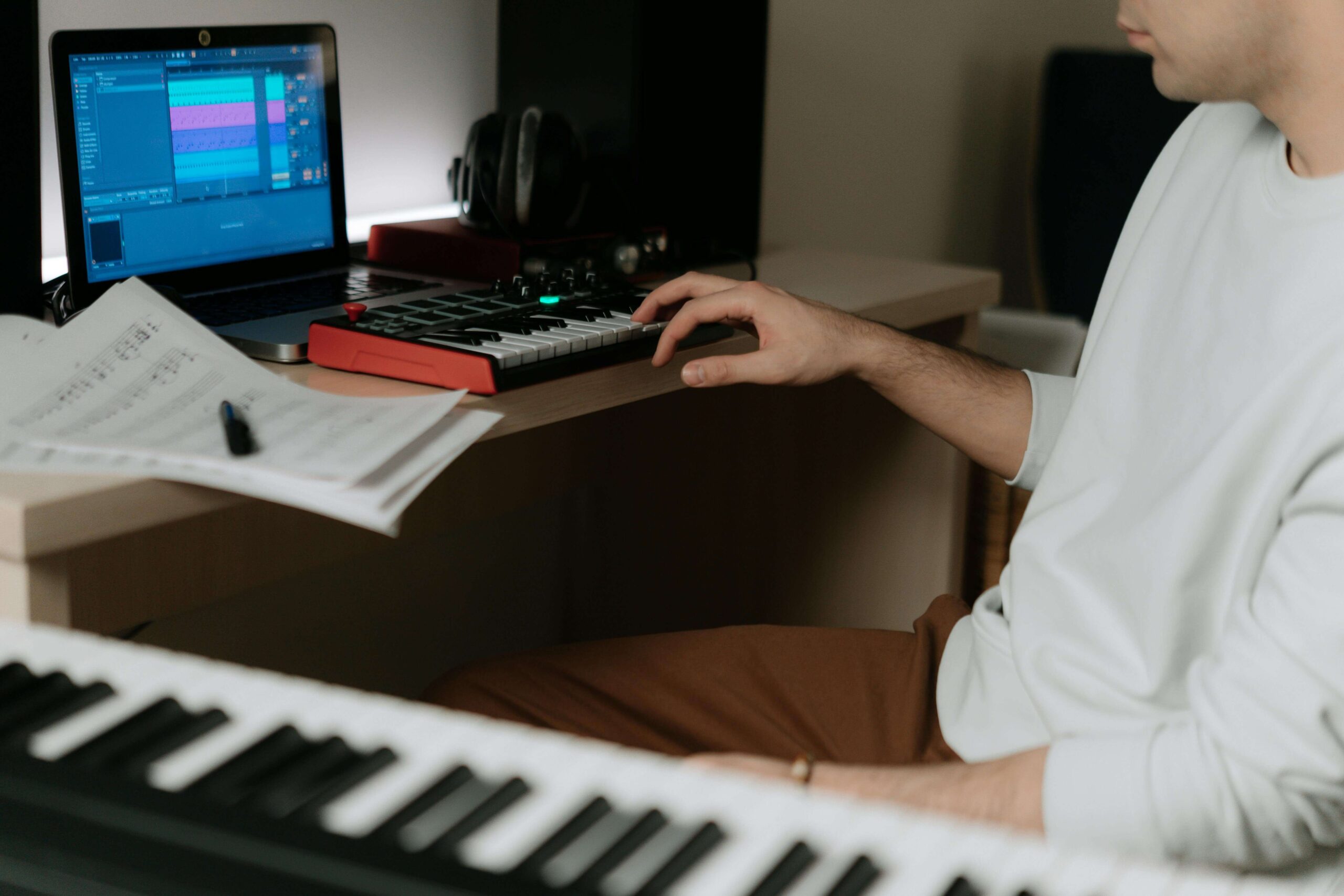
The rise of AI-generated music has sparked ongoing debates about the nature of creativity.
Some critics fear that AI could replace human musicians, while others believe it will simply become another creative tool.
Most experts agree that human creativity remains essential in the music industry. While AI can generate melodies and patterns, it still relies on human guidance, interpretation, and emotional understanding.
Instead of replacing artists, AI may expand the boundaries of musical experimentation.
Conclusion
Artificial intelligence is rapidly changing the landscape of music creation. Through advanced machine learning techniques, AI systems can generate melodies, harmonies, and full compositions that sometimes rival human-made music.
Blind listening tests reveal that many listeners cannot easily distinguish between human and AI-generated songs, highlighting the impressive capabilities of modern AI music generation technologies.
However, AI music also raises important questions about creativity, originality, and the role of human emotion in art.
As technology continues to evolve, the most exciting future for music may lie not in competition between humans and machines, but in collaboration. By combining human imagination with AI-powered tools, musicians can explore new creative possibilities and shape the next generation of musical expression.