

Generative AI is changing how scientists process and interpret the enormous amount of data collected by modern telescopes. AI image enhancement in astronomy has emerged as a key solution to these challenges, helping researchers analyze distant galaxies, nebulae, and stars by reducing noise and improving data accuracy across massive datasets..
Using AI image enhancement in astronomy offers a practical solution to these challenges by restoring faint signals and reducing noise. Artificial intelligence models can help researchers enhance astronomical images, remove unwanted noise, reconstruct missing information, identify important structures, and create useful representations of complex cosmic data.
Unlike traditional image-processing methods that rely heavily on fixed rules, modern AI models can learn patterns from large datasets and apply that knowledge to new observations. This makes Artificial intelligence a valuable research assistant for astronomers, astrophysicists, and space scientists.
However, AI-generated results must be treated carefully. A visually impressive image is not automatically a scientifically accurate one. Human experts, original observations, and rigorous validation remain essential.
What Is Generative AI in Astronomy?
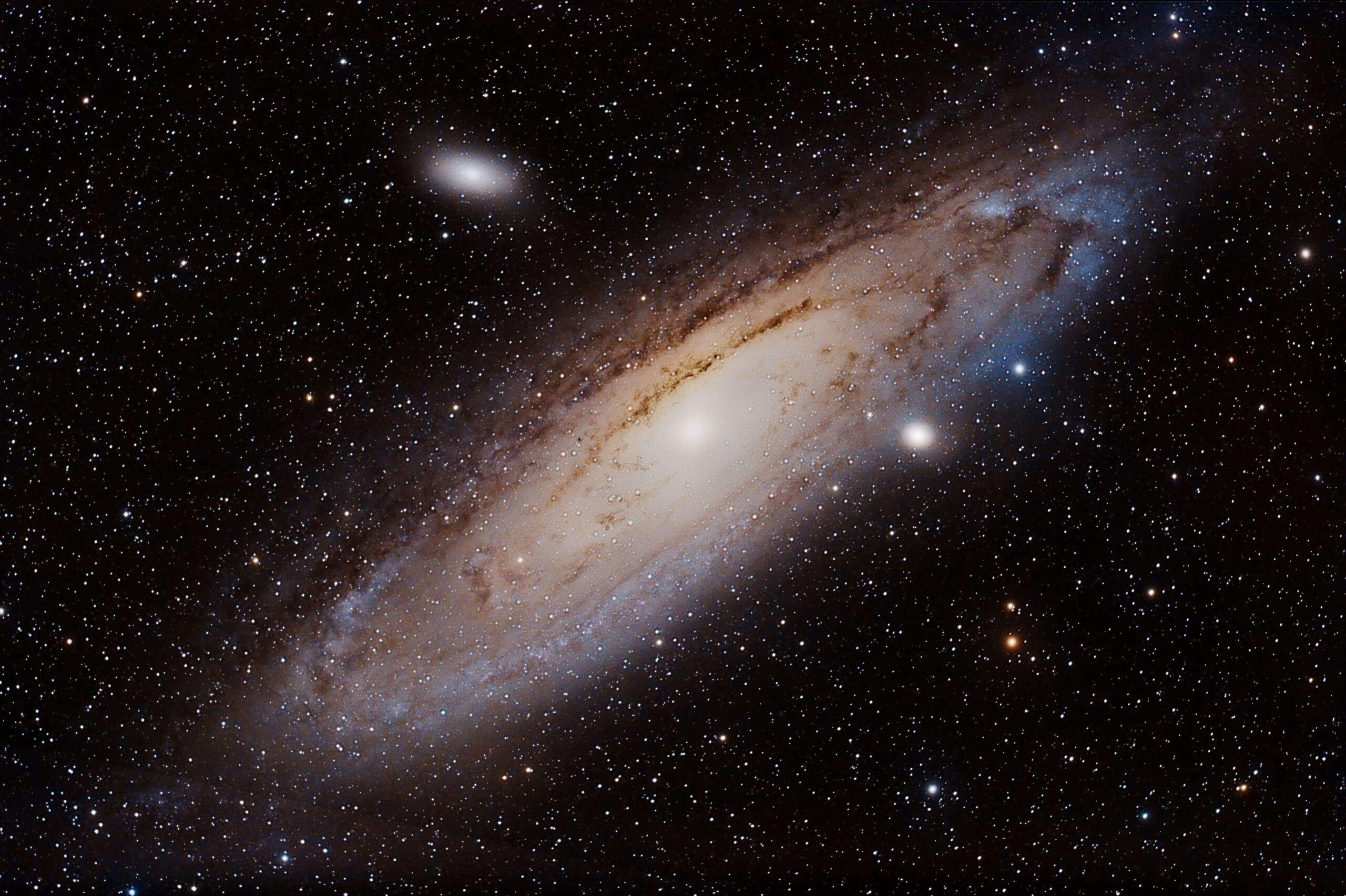
Understanding AI-Powered Astronomical Research
Generative AI refers to artificial intelligence systems that can produce new content or reconstruct information based on patterns learned from existing data. The application of Generative AI in astronomy allows these capabilities to be used across images, simulations, observational datasets, and other forms of scientific information..
Astronomers can train AI models using large collections of galaxy images and simulations. The models learn characteristics such as galaxy shapes, brightness patterns, spiral structures, cores, halos, and other observable features.
Once trained, these systems can assist researchers with tasks that would otherwise require significant manual effort.
For example, an AI model may analyze an astronomical image and produce a cleaner representation that makes a galaxy’s major structures easier to study. This does not mean the AI has discovered the galaxy’s true appearance independently. Instead, it has generated an interpretation based on patterns learned from its training data.
Why Galaxy Images Are Difficult to Analyze
Astronomical images are fundamentally different from everyday photographs. Telescopes often observe objects that are extremely distant and faint, meaning the incoming signals can be affected by instrument limitations, atmospheric conditions, background radiation, and other sources of noise.
A single image may contain:
- Faint celestial objects
- Background noise
- Blurred structures
- Overlapping galaxies and stars
- Incomplete observations
- Instrument-related artifacts
- Extremely subtle features
Astronomers therefore use sophisticated image-processing techniques before interpreting observations.
Generative AI can complement these techniques by learning complex visual patterns and helping researchers identify meaningful structures within large datasets.
How Generative AI Differs From Traditional Processing
Traditional astronomical image processing often uses mathematical models, predefined filters, calibration techniques, and carefully designed algorithms. These methods remain extremely important and are not being replaced by AI.
Generative AI provides an additional layer of flexibility. Instead of relying only on predetermined rules, AI models can learn relationships from large collections of observations or simulated data.
Techniques such as generative adversarial networks (GANs), variational models, and diffusion-based approaches can potentially support image restoration, denoising, reconstruction, and scientific visualization.
The key advantage is not simply producing better-looking images. The goal is to extract useful information while preserving scientific validity.
How Generative AI Improves Galaxy Image Processing
Denoising and Image Enhancement
One of the most effective uses of AI image enhancement in astronomy is reducing background noise while preserving faint celestial details. Noise can make faint galaxy structures difficult to identify, especially when observations involve extremely weak signals.
Generative AI models can learn the difference between meaningful astronomical structures and common noise patterns. They can then produce enhanced representations that make important features easier to inspect.
For example, an AI system may help reveal the apparent structure of spiral arms within a noisy observation. Researchers can use the enhanced image as an additional analytical aid while comparing it with the original telescope data.
This approach can save time and help scientists prioritize observations that deserve closer investigation.
Reconstructing Missing or Incomplete Information
Astronomical datasets are not always complete. Observations may contain gaps because of sensor limitations, observation conditions, technical problems, or other factors.
AI models can assist with reconstruction by learning patterns from related observations and simulations. A model may estimate what a missing region could look like based on surrounding information and learned astronomical structures.
This capability can be useful for visualization and exploratory research, but it requires careful validation. An AI reconstruction is an estimate—not direct observational evidence.
Researchers should therefore distinguish clearly between original telescope observations and AI-generated or AI-enhanced content.
Highlighting Important Cosmic Structures
Galaxy image processing is not only about making images sharper. Scientists also need to identify structures that may have scientific significance.
Generative AI can help create simplified representations that emphasize features such as:
- Spiral arms
- Galactic cores
- Stellar distributions
- Dust structures
- Galaxy halos
- Irregular shapes
These representations can support galaxy classification, anomaly detection, and large-scale astronomical surveys.
AI-assisted visualization can also make complex datasets easier to compare, helping researchers identify patterns across thousands or millions of observations.
Benefits and Challenges of AI-Powered Astronomy
Faster Astronomical Data Analysis
Modern astronomy produces enormous datasets. Large observatories and sky surveys can collect more information than researchers can reasonably inspect manually.
AI can automate portions of image processing and data analysis, allowing scientists to examine large numbers of observations more efficiently.
Instead of manually reviewing every image from the beginning, researchers can use AI systems to prioritize unusual objects, identify potential patterns, and organize observations for further study.
This can make astronomical research faster while allowing scientists to spend more time on interpretation and hypothesis development.
Better Support for Classification and Discovery
AI can assist with classifying galaxies according to their observed characteristics. For example, machine learning systems can distinguish among broad categories such as spiral, elliptical, and irregular galaxies.
Generative AI can complement classification systems by improving or transforming the data used for analysis.
AI can also help identify anomalies—objects or structures that do not closely match expected patterns. These unusual observations may deserve additional investigation because they could reveal previously overlooked phenomena.
Importantly, an AI-generated anomaly is a research lead, not automatically a scientific discovery. Astronomers must validate unusual findings using original observations and established scientific methods.
Risks, Bias, and Scientific Reliability
Generative AI also introduces important challenges.
One major concern is hallucination. An AI model can generate plausible-looking structures that are not actually present in the original observation. In scientific research, this can be especially dangerous because visual plausibility does not guarantee factual accuracy.
Training data can also introduce bias. If an AI model learns primarily from particular types of galaxies, simulations, or observational conditions, its outputs may not generalize equally well to every astronomical dataset.
Researchers should therefore evaluate model performance carefully and preserve access to the original data.
A reliable AI-assisted astronomy workflow should include transparency, reproducibility, uncertainty assessment, and human expert review
Applications and Future of Generative AI in Astronomy
Supporting Telescope Data and Space Missions
The role of AI image enhancement in astronomy will grow rapidly as next-generation telescopes collect massive sky-survey datasets.
AI systems may assist with preliminary processing, image enhancement, object detection, and data prioritization. This could be particularly valuable for large-scale sky surveys where researchers must process enormous numbers of observations.
In future workflows, AI could help identify potentially interesting observations soon after data is collected, allowing researchers to respond more quickly to unusual astronomical events.
AI can also support simulations that model complex astronomical environments, helping scientists compare theoretical predictions with observational evidence.
Making Astronomy More Accessible
Generative AI can also help educators, students, and citizen scientists understand complex astronomical information.
Astronomy datasets can be difficult for beginners to interpret. AI-assisted visualizations can simplify complex information and make galaxy structures easier to understand without requiring advanced technical knowledge.
Educational platforms could use AI-generated explanations and visual representations to introduce concepts such as galaxy formation, stellar evolution, cosmic structures, and astronomical observation.
Citizen science projects may also benefit when AI helps organize or simplify large datasets for human participants.
However, educational materials should clearly distinguish scientifically verified observations from AI-generated visualizations.
The Future of AI and Scientific Discovery
The future of Generative AI in Astronomy will likely involve closer collaboration between AI systems and human researchers rather than complete automation.
Potential developments include:
- Real-time AI-assisted telescope image processing
- More accurate astronomical image reconstruction
- AI-generated simulations of galaxy formation
- Automated identification of unusual cosmic objects
- Improved AI models for large-scale sky surveys
- AI-assisted analysis of multiwavelength astronomical data
- More transparent systems for scientific uncertainty
- Human-AI collaboration in space science research
As models become more capable, their usefulness will depend not only on image quality but also on scientific reliability.
The strongest approach will combine AI’s ability to process massive datasets with the expertise of astronomers who understand observational limitations, physical laws, and scientific context.
Key Takeaways and Conclusion
What Generative AI Means for Astronomy
Ultimately, AI image enhancement in astronomy works best when combined with human expertise and rigorous scientific validation.” It can assist with image denoising, enhancement, reconstruction, visualization, classification, and large-scale data analysis.
Its greatest value comes from helping researchers work with datasets that are too large or complex to analyze efficiently using manual methods alone.
Why Human Validation Still Matters
AI should not be treated as an independent source of scientific truth. An AI-generated image can contain artifacts or invented features that appear realistic but are not supported by the original observation.
Astronomers must compare AI outputs with raw data, established models, simulations, and independent observations.
Human expertise remains essential for deciding whether an AI-generated result has genuine scientific meaning.
Conclusion
Generative AI in Astronomy is opening new possibilities for studying galaxies and the wider universe. By helping researchers process massive datasets, enhance astronomical images, identify patterns, and explore complex simulations, AI can accelerate scientific workflows and support new research.
At the same time, responsible implementation is critical. Scientific accuracy, transparency, validation, and human oversight should remain central to every AI-assisted astronomy workflow.
The future of astronomy is therefore unlikely to be AI versus humans. Instead, it will increasingly be AI working alongside astronomers, combining computational scale with human scientific reasoning to better understand the universe.